
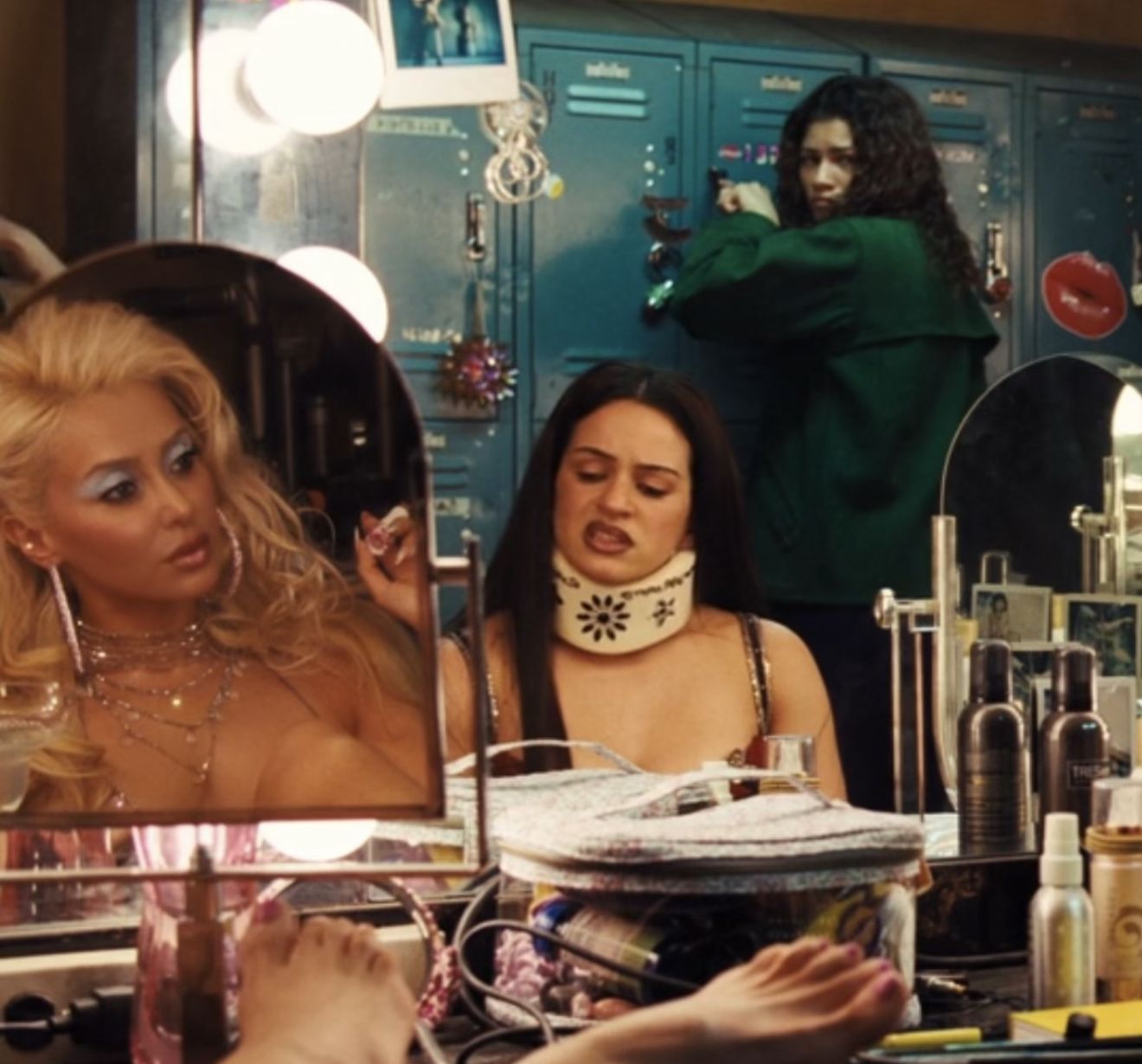
For Iranian-American actress and model Jewell Farshad, stepping onto the set of HBO’s Euphoria was about more than landing another acting role. It was a full-circle moment.
Born in Tehran, Farshad left Iran as a teenager and eventually built a career in Los Angeles as an actress, model, and content creator. Her journey from Iran to Hollywood has been shaped by a desire to create opportunities that she once could not imagine for herself—and, more importantly, to make those possibilities visible to other women.
In Season 3 of Euphoria, Farshad portrays Penelope, bringing a glamorous, larger-than-life Persian presence to the HBO series. For Farshad, the role was particularly meaningful because she was not asked to play a stereotypical Middle Eastern character.
“I loved that I got to play this over-the-top blonde bombshell with crazy fun hair and outfits,” Farshad says. “I wasn’t cast as a typical Middle Eastern character. I got to just be a woman, a character, and have fun with it.”
That distinction matters.
For decades, Middle Eastern characters in Western entertainment have often been confined to narrow representations—defined by war, terrorism, oppression, immigration, or cultural stereotypes. Farshad’s portrayal of Penelope offers something different: a Persian actress simply inhabiting a glamorous, complicated, unapologetically feminine character in the same way any other actress would.
Representation Beyond the Stereotype
Farshad describes her Euphoria experience as an opportunity to show audiences another side of Persian identity.
Her scenes place her alongside some of the biggest names in contemporary television, including Zendaya and global recording artist Rosalía. The experience also created unexpected moments of cultural exchange behind the scenes.
Farshad recalls teaching Rosalía Farsi while Rosalía taught her Spanish between takes. Some of their interactions were spontaneous and improvised, creating a genuine exchange between two women from different cultural backgrounds.
For Farshad, those moments represented what she believes entertainment can do at its best: bring people together who might otherwise never meet.
Her presence on Euphoria is also significant because she is believed to be the first Iranian actress featured on the series. Rather than treating that distinction simply as a career milestone, Farshad sees it as part of a larger conversation about who gets to be visible in Hollywood.
“I dreamed of Hollywood so that one day a girl in Iran could see a beautiful Persian woman on screen—not a terrorist, but a leading woman. Powerful. Free. Seen.”
That dream has remained central to Farshad’s career.
From Tehran to Los Angeles
Farshad’s Hollywood journey began long before Euphoria.
At 18, she left Tehran for the United States after winning the U.S. Green Card Lottery. She arrived in Los Angeles determined to build a life in an industry she had admired from afar.
She eventually earned a B.A. in Los Angeles and developed a career spanning modeling, acting, and digital media. She has appeared in television and film projects, worked in fashion, appeared on international magazine covers, and built a significant audience online.
Her modeling career has also been closely connected to her advocacy for petite women and greater diversity within the fashion industry.
But acting has always represented something deeper.
Hollywood offered Farshad a chance to create the kind of image she wanted young Iranian women to see: someone who could be glamorous without being reduced to a stereotype, ambitious without apology, and culturally Persian while fully participating in American popular culture.
The Power of Playing Someone Unexpected
There is something particularly refreshing about Penelope’s introduction to Euphoria.
She is not defined by her ethnicity.
She is blonde, glamorous, outrageous, fashionable and larger than life. Her hair and wardrobe are intentionally extravagant, and her presence feels completely at home in the heightened universe of Euphoria.
For Farshad, that freedom was part of what made the character so enjoyable.
“I loved the hair, the outfits, the whole energy of her,” she says. “It was so much fun to step into someone who was completely over the top.”
The significance is subtle but powerful. Representation does not always have to mean telling a story specifically about someone’s culture. Sometimes representation means allowing an actor from an underrepresented background to play a character whose ethnicity is not the entire point of the story.
A Persian actress can be glamorous.
She can be funny.
She can be complicated.
She can be the blonde bombshell.
She can simply be Penelope.
Bringing Persian Identity to a Global Audience
Farshad has spent much of her career navigating the space between cultures. She is fluent in English and Farsi, with proficiency in Arabic and French, and has used her social media platforms to connect audiences with fashion, beauty, entertainment, and Persian culture.
Her digital presence has become another way of telling stories about Iranian women that challenge familiar narratives.
Through platforms such as Instagram, Farshad has built a community around beauty, fashion, acting, and empowerment while continuing to represent her Persian heritage on an international stage.
For Iranian women watching from outside the United States, her journey carries a particular resonance. She is someone who left Tehran as a teenager and built a career in one of the world’s most competitive entertainment industries.
Her story is not simply about arriving in Hollywood. It is about refusing to believe that the circumstances of one’s birthplace should determine the limits of one’s future.
A New Image of the Iranian Woman
Farshad’s appearance on Euphoria arrives at a time when global audiences are increasingly interested in Iranian culture and the stories of the Iranian diaspora.
Yet representation still matters because visibility shapes perception.
When audiences repeatedly see Middle Eastern women portrayed through a limited set of images, those images become assumptions. But when audiences see Iranian women occupying completely different spaces—actors, models, artists, entrepreneurs, athletes, filmmakers, executives and creators—the definition expands.
Farshad hopes to contribute to that expansion.
“I came here for every girl in Iran who was told her dreams were impossible,” she says.
For her, playing Penelope is therefore both personal and symbolic. It is a reminder that an Iranian actress does not have to choose between her heritage and her Hollywood identity.
She can carry both.
Looking Beyond the Screen
Farshad’s ambitions extend beyond acting. Her work in modeling, digital media, and women’s empowerment has become part of a broader mission to encourage women to take ownership of their identities and futures.
She has supported organizations focused on women’s rights and education, including the United Nations and the Malala Fund, while using her own career as an example of what can happen when women are given the freedom to pursue their ambitions.
Her story began in Tehran and continued in Los Angeles. Now, through Euphoria, it reaches an international audience.
For a young woman watching from Iran, seeing an Iranian actress on one of television’s most recognizable shows can mean more than seeing a familiar face.
It can mean seeing a possibility.
And perhaps that is the most meaningful part of Jewell Farshad’s journey: she is not only appearing on screen. She is helping expand the idea of who an Iranian woman can be.
About Jewell Farshad
Jewell Farshad is an Iranian-American actress, model, and content creator based in Los Angeles. She has appeared in television and film, worked internationally in fashion, and built a career focused on entertainment, representation, and women’s empowerment. Her role as Penelope on HBO’s Euphoria marks another milestone in her journey as one of the Iranian actresses bringing Persian representation to mainstream American entertainment.